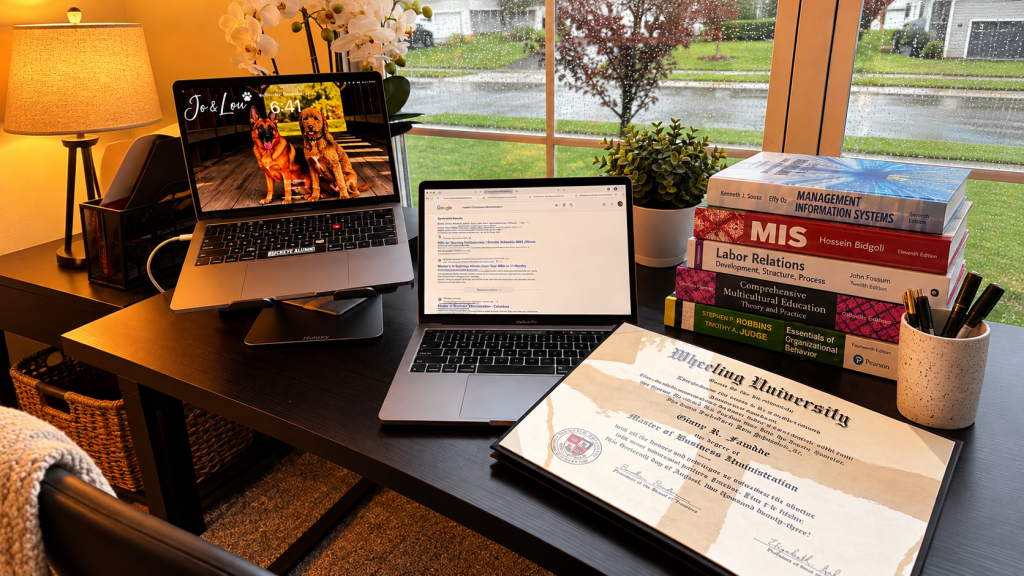
When people picture a “nontraditional student,” they usually picture someone in their twenties, juggling a toddler and a night class. Almost nothing gets written about the other kind of nontraditional student: the one returning to the classroom decades later, when your children are grown and building their own lives, your career is at its most demanding, and there is no obvious hour left in the day to give away.
I was that student. For two years, while I was president of a university that was struggling financially and facing a critical accreditation review, I worked roughly eighty hours a week. I attended evening events almost every week of the year, because that is what the job asked of me. And in the middle of all of it, I went back to school for my MBA. I did not have a spare hour. I made one anyway.
My oldest, Cecelia, had made me promise something before I ever took the job. She had watched me take on hard roles before and pour everything I had into them, only to come out the other side exhausted. She asked me not to do it again. And she was right. I knew she was right. So I promised her, and myself, that I wouldn’t.
I tried to keep that promise in year one. I signed up for classes, and within weeks I knew it was impossible. The university was dealing with serious financial problems, its accreditation was at risk, and turning it around left nothing over. I withdrew, told my family I’d come back to the idea when the time was right, and went back to work. Two months later, COVID shut the world down. Our students were sent home by government order. We laid off a significant number of employees, moved others to remote work, and tried to prepare a small, struggling university for its ten-year accreditation review with the Higher Learning Commission, largely with a staff who, like me, were new to higher education administration and had never been through an accreditation cycle before. Jobs, and the university’s ability to keep its doors open at all, were riding on that review. We stumbled through it. We survived COVID, survived the review, and got our students back on campus in the fall. That part of the story is its own article. It’s too much to shortchange here.
Once the university had stabilized, I went back to school. This time I finished. But “finished” doesn’t say much about what the next two years actually looked like.
What Two Years Like That Actually Looked Like
Here is a week, more or less any week, for two years: full days at the university, managing problems that did not wait for me to finish a class assignment. And then there were the students. Because we didn’t live on campus, I worked hard to be there. I was at their games, their events and the things that mattered to them. My husband and I routinely joined students for dinner. We wanted to be part of the university community, not simply show up as president when the job required it. That was what the job meant to me. It wasn’t simply being president. It was being part of a family. Then Sunday. Every Sunday, no exceptions, at the dining room table, working through readings, discussion posts, papers, and exams, because Sunday was the only day nothing else had already claimed. If I traveled for a conference, I did coursework in the airport, on the flight, and in the hotel room after the last session ended. There was no light week coming. I stopped waiting for one.
Eighty-hour weeks running a university, on top of a full graduate course load, for two straight years, is not something you gut through on willpower alone. I was exhausted in a way that doesn’t fully translate into a sentence. I said no to things I wanted to say yes to. I missed sleep I never got back. There were Sundays I sat down at that table with nothing left to give and made myself write the paper anyway, because the alternative was falling behind on a degree I had already sacrificed too much to abandon a second time. I didn’t have the luxury of a bad week derailing me. I didn’t have the luxury of quitting quietly and no one noticing, because I had already quit once, and I’d promised myself I wouldn’t do it twice.
I also stopped trying to be perfect at the coursework. I was already spending every ounce of perfectionism I had on the university, on the accreditation review, on payroll, on the students. School had to be the place where “good enough and done” was allowed to be true. Get it in. Learn what I needed. Move to the next fire.
The program was entirely online, so I never sat in a classroom, but I wasn’t invisible either. Every class required posting on classmates’ work, and they posted on mine. They knew exactly who I was, a university president doing the same reading and writing assignments they were. Not one of them ever made an issue of it. There was something steadying about that. I wasn’t hiding from my classmates, I was simply one more name in the discussion thread, judged on the work like everyone else.
The one thing that made it survivable, and not just endurable, was that the two halves of my life started feeding each other instead of competing. I wasn’t reading case studies about leadership and finance in the abstract. I was living one, in real time, with real payroll and real accreditors watching. I could take what I was learning on a Tuesday and use it in a board meeting on Wednesday. Higher education leadership requires real business acumen, whether or not anyone hiring a college president wants to admit that, and I was learning it in real time, on my own dime and my own hours.
That last part mattered more than I expected it to. I did every bit of that coursework on my own personal time, deliberately, because I never wanted my education to come at the expense of the university or the students I was there to serve. Outside my family, only my professors and my vice president of academic affairs knew I was in the program. I kept it private from the rest of my staff because I wanted to keep the focus where it belonged. I was investing in myself, but I was also deeply committed to the job I had taken on. I wanted to finish the degree knowing I had given both the university and the program everything I had. Looking back, I think part of me also understood that this was something I needed to carry quietly until it was finished. It was personal. It was mine. And by the time I finally had that degree in my hands, it meant far more to me than I could have imagined when I enrolled.
I told very few people I was earning the degree. It was personal for me, and in some ways, it became a testament to how much the university had come to mean to me. I wasn’t only earning a master’s degree. I was becoming an alum of the very school I was working so desperately to turn around. Somewhere along the way, Wheeling University had become part of me and part of my own story. My assistant and my Chief Information Officer were among the few people who knew. My CIO was a Wheeling alum herself, and she loved that school in the way you only love a place that helped shape you. I knew she would understand what it meant to me. I chose not to walk in the commencement ceremony, and I asked to be left out of the program entirely. I didn’t want the attention to be on me. That day belonged to my students. But the degree itself was mine. It hangs on my wall today, and when I look at it, I don’t just see an MBA. I see a chapter of my life, a university I came to love, and a time when I was trying desperately to help save a place that had, in the process, become part of my own story.
Something to Show for It
Here is what two years like that taught me about hard seasons: they rarely arrive on a convenient timeline, and they never announce themselves when you’re rested and ready. Mine arrived in the middle of a financial crisis, a pandemic, and an accreditation review that could have closed the university’s doors, stacked on top of eighty-hour weeks and a full course load, for two years with no real break in between. I could have waited for calmer waters. Calmer waters never came, for me or for anyone I have ever known.
I didn’t earn that MBA to prove anything to the university. I worked hard, stayed focused on the institution I was leading, and earned a graduate degree at the same time, on my own time, because I refused to let one more hard season end with nothing of my own to carry out of it. It made me sharper. It made me more disciplined. I came out of that program with a stronger understanding of the business side of higher education, and I believe I was a better president because of it. I have given a great deal of myself to institutions over the years and left many of them better than I found them. This time, I made certain that when I eventually walked away, as I have walked away from other demanding roles before, I would be walking toward something instead of just away from something.
I think that’s what I understand differently now about reinvention.
Sometimes you don’t get to wait for the perfect time. Sometimes life is already full, the calendar is already crowded, and there isn’t going to be a convenient season when everything gets easier.
What matters is deciding what is worth making room for.
I didn’t know it at the time, but earning that degree was about more than an MBA. It was something I chose for myself in the middle of a season when almost everything else I was doing belonged to someone else.
And maybe that’s why it still matters to me.
I walked away from that chapter with something that was mine.
Maybe that’s part of what a second chapter is about.



Leave a Reply