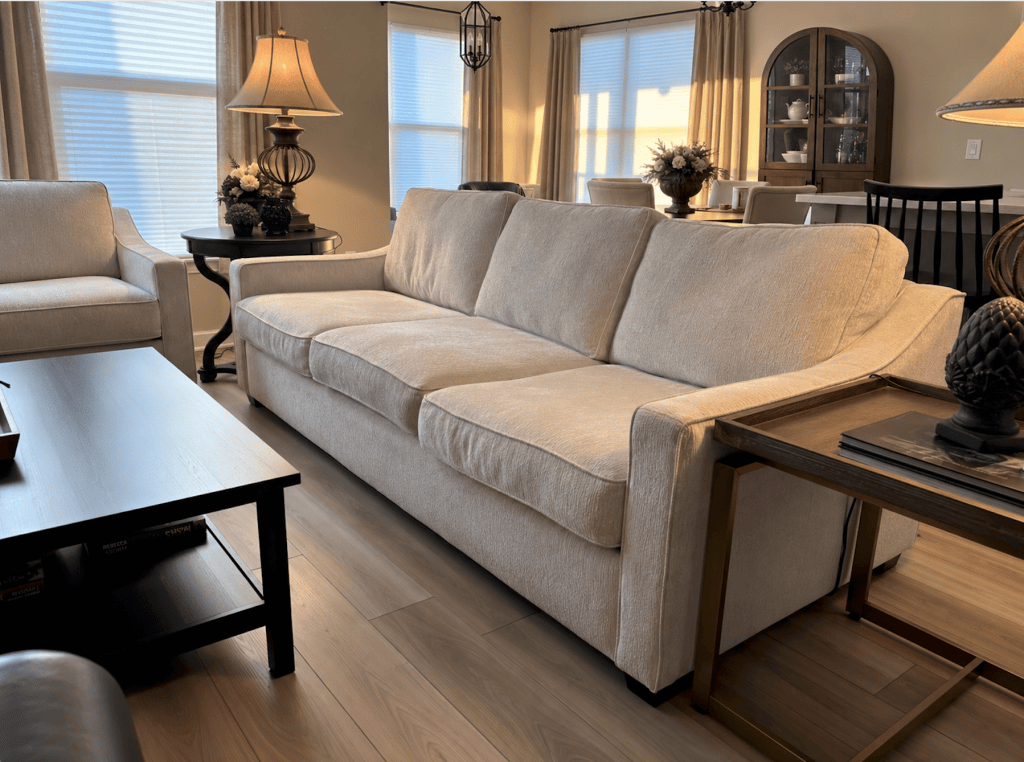
We’ve downsized twice in the last five years, and neither time went the way I pictured it.
The first time was during the actual COVID shutdown, which is its own special kind of chaos when you’re trying to empty a house. A yard sale is hard to pull off when nobody wants to stand shoulder to shoulder digging through boxes. We sold what we could on Facebook, held the sale anyway, masked up, and did our best. And still, we filled a 20-foot roll-off dumpster. Twice. Things we’d carried from house to house for years went straight into it, and I don’t remember mourning a single item.
The second time was mid-2024, moving into the ranch we live in now. That’s the move that actually changed how I think about stuff, because it wasn’t chaotic like the first one, and it came with an uncomfortable discovery: a lot of what I’d boxed up back in 2020 was still boxed up, untouched, four years later. I hadn’t opened it once. Not out of laziness. I had simply never needed to.
So this time, I made a sincere effort to open every box and actually question what was in it. Closet after closet, drawer after drawer, bookshelf after bookshelf, I asked myself the obvious question first: how long has it been since I used this, and how likely am I to use it again anytime soon? But I also started paying attention to something less practical: how the item felt when I picked it up or looked at it. Was it beautiful to me? Was it precious? Did it actually bring me joy, or was I just used to having it around? I donated more bags of clothing than I care to admit, and gave away larger pieces to neighbors who’d always coveted them, including two hand-carved cardinal birds, carved with a chainsaw.
The honest answer, for a lot of it, was “just in case.” Special dinner plates I used twice a decade. Serving dishes for gatherings I hadn’t hosted in years. Christmas decorations for three rooms, in a house where we now decorate one. Sports equipment from two kids who each played three sports and who are now well into their college years and beyond, building their own lives, in their own homes, with their own gear.
None of it was doing anything for me except taking up space and, if I’m honest, quietly tying me to a version of our life that had already moved on.
Somewhere along the way, I realized I had become a minimalist. I practice not buying things, which sounds like deprivation until you actually try it and realize how rarely you think of something you truly need that you no longer have. It happens far less than you’d expect. And on the occasions it does happen, Amazon can have it on my porch by 8 a.m. tomorrow. That’s not a punchline. It’s genuinely part of how I’ve made peace with owning less. “Just in case” used to mean keeping something for years on the off chance I’d need it. Now it means trusting that if I actually need it, I can get it.
It’s not really about getting rid of things. It’s about learning what is enough.
Enough is different from simply having less. Less can sound like deprivation, like you’re bracing to go without something you’ll eventually need. Enough means everything required for a full, good life is already in your hands, nothing missing, and nothing extra weighing you down.
Seneca wrote, “True happiness is to enjoy the present, without anxious dependence upon the future.” I didn’t fully understand that until I stopped keeping so much of my past stacked in boxes around me. I had spent years holding onto things because I might need them someday, without stopping to ask whether keeping them was helping me enjoy the life I had today. I don’t want to live tethered to my past life. I want to live in the now, today, this chapter, not the one that already happened.
And I don’t want my kids, someday, standing in a house going through four or five decades of marriage worth of belongings, having to decide what mattered to us and what didn’t. That’s not a gift to leave behind. It’s a burden dressed up as sentiment.
Maybe that’s what downsizing has really taught me. A second chapter isn’t just about deciding what you want to add to your life. Sometimes it’s about deciding what you don’t need to carry forward.
I’ve spent a lot of years collecting things, responsibilities, expectations and versions of myself that made sense at the time. Some of them still do. Some don’t.
I’m learning that making room for what’s next sometimes means being willing to let go of what’s already served its purpose.
So here’s where I’ve landed: keep what’s truly precious. Photos. Books. The handful of collectibles that actually mean something, not just occupy a shelf. The things I use to live my actual daily life, today. Everything else, the “someday” plates, the “just in case” boxes, I’ve let go of, and I have yet to regret it.
Maybe that’s what owning less has really given me. Not an emptier house, but more room to notice the life I actually have.
I don’t need to keep everything from the life I’ve already lived in order to honor it. I can keep what matters, let go of what doesn’t, and trust that the memories aren’t stored in the boxes anyway.
If you’re standing in a garage or a closet right now, staring at something you haven’t touched in years and keeping it “just in case,” I’d ask you the same question I had to ask myself: in case of what, exactly? And is the case worth the space it’s taking up in your life today?
What’s the one thing you’re still holding onto “just in case,” and what would it take for you to finally let it go?




Leave a Reply