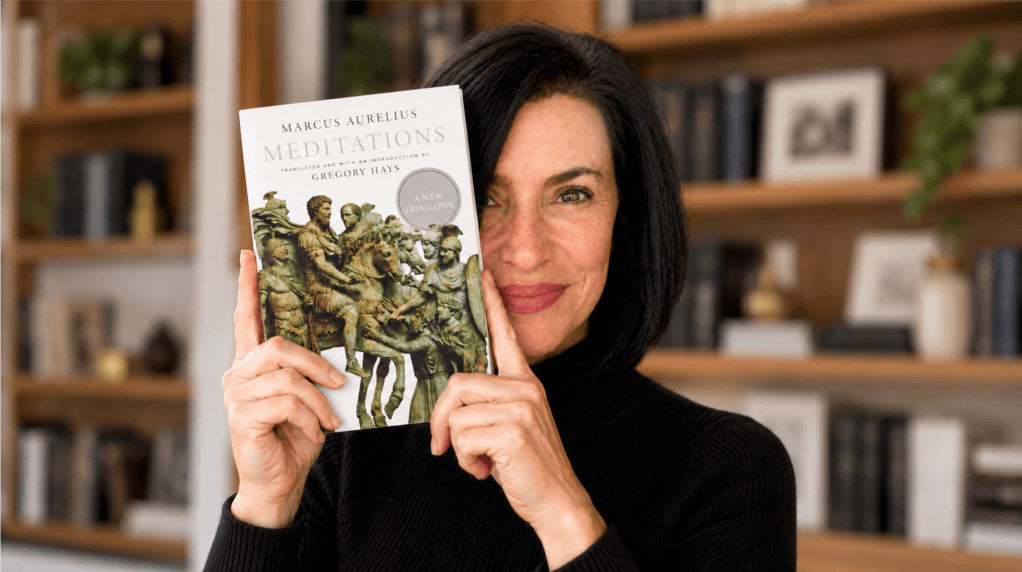
I have always been a reader. Bestsellers, whatever’s on Reese Witherspoon’s book club list one month, whatever’s on Candace Owens’ the next. Self-help, leadership, organizational turnarounds, motivation, business improvement, if it’s a book, I’ll probably read it. I’ve always said that if someone knows enough about a subject to write a whole book on it, they know more than I do, and that’s reason enough to pick it up.
I also have a somewhat obsessive fondness for quotes. I think that’s actually how I stumbled into my most recent reading obsession: Stoicism.
I ran across a line from Marcus Aurelius, “You have power over your mind, not outside events. Realize this, and you will find strength,” and it hit me hard. The core idea is simple to say and genuinely difficult to live: you cannot control what happens around you, only how you respond to it. Real peace, real mental freedom, comes from putting your energy into your own thoughts and your own actions, rather than into the events or people you were never going to control in the first place.
I went through a genuinely difficult stretch a few years back, one I’m still working through pieces of even now, and that quote landed differently because of it. It wasn’t abstract philosophy to me. It was something I needed.
That single quote led me to Meditations, Marcus Aurelius’s own journal, his private thoughts written for no one but himself, which is part of why it still feels so honest almost two thousand years later. I put myself on the waiting list at the Columbus Metropolitan Library and, believe it or not, was 12th in line for a copy. Twelve people, in one city, all reaching for the same journal from a Roman emperor at more or less the same moment. There’s something reassuring in that.
For anyone who didn’t spend a semester on it in a philosophy class, Stoicism is an ancient Greek and Roman school of thought built around a handful of practitioners you’ve probably heard of even if you didn’t know the label: Marcus Aurelius, a Roman emperor who wrote his private journal in the middle of running an empire; Seneca, a statesman and playwright; and Epictetus, who started life enslaved and became one of the philosophy’s clearest teachers. What interested me wasn’t the history for its own sake. It was that these were people with real responsibilities and real hardship, trying to figure out how to live well anyway.
From Meditations I moved on to Lives of the Stoics, and from there into my own ongoing, imperfect attempt to actually practice parts of this philosophy rather than just read about it. In practice, that mostly comes down to one habit: pausing, in a hard moment, to ask myself what’s actually within my control and what isn’t, and then only spending my energy on the first list. It sounds simple written out like that. It is not simple to actually do. But it’s gotten easier with practice, the way anything does.
What surprised me most was how much this idea challenged my own thinking. Stoicism asks a lot of the people who practice it. It calls for honesty about our flaws, a willingness to be uncomfortable, and a recognition that sometimes we need to do better. But as I read more, I began to see another side of it.
One of the early Stoics, Cleanthes, once overheard a fellow philosopher criticizing himself harshly when he thought no one was listening. Cleanthes stopped him and reminded him that he wasn’t talking to a bad man. That story stayed with me. Seneca wrote something similar late in his life, describing how he was still, even as an old man, learning to be his own friend. The same man who practiced going without and forced himself into cold rivers to strengthen his discipline was also thinking about how to treat himself with the warmth he’d offer someone he loved.
That distinction matters more than almost anything else I’ve taken from this whole reading journey. The goal was never self-punishment. It was self-improvement, and nobody actually improves for a teacher who despises them. So the real practice, alongside the discipline, is asking yourself some gentler questions too. Do you know you’re a good person? Are you your own friend? Can you catalog your own strengths as honestly as you catalog your flaws, and actually say “good job” to yourself when it’s earned?
Maybe that’s part of what this stage of life has taught me. We spend so much time becoming good at recognizing what needs to be fixed, improved or changed. We can become very good at seeing our own shortcomings too.
But there is something different about learning to look at yourself with the same honesty and grace. Maybe being your own friend isn’t about letting yourself off the hook. Maybe it’s about believing you’re worth the effort of becoming better.
I don’t think you have to overhaul your entire worldview or start quoting Latin to get something real out of Stoicism. Even the smallest piece of it, that one idea that you control your response even when you control nothing else, can change how you move through a hard day, a hard year, or a hard season of life. It did for me. Some philosophies stay in the book. This one followed me out into my actual life, and I’m better for having let it in.
What did this 2,000-year-old quote teach me about being my own friend? It taught me that self-improvement and self-compassion aren’t opposites.
You can expect more from yourself without constantly tearing yourself down. You can admit where you need to grow while still recognizing what you’re doing well. And sometimes, especially in a second chapter, you need to become the person who is willing to stand in your own corner.
What’s a book, or even just a single line from one, that changed how you think? I’d love to hear it.




Leave a Reply